


24th October 2025: John O’Gallagher’s New Album ‘Ancestral’ available now on all platforms…
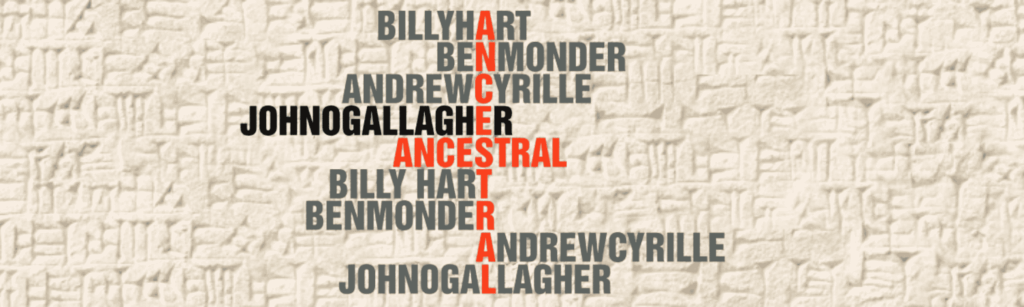
John O’Gallagher’s new album ‘Ancestral’ out now on all platforms
CD / DL / 180 gram LP
ABOUT THE ALBUM
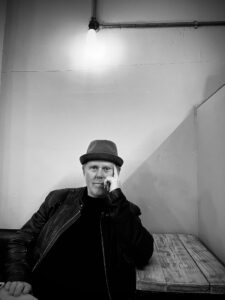 Ancestral marks a profound metamorphosis for master saxophonistJohn O’Gallagher. He cast off his old skin, fundamentally altering his studies, homeland, and life, thereby charting a new future. Recorded at Sound on Sound Studios in Montclair, New Jersey, in January, 2024, Ancestral was influenced, in part, by O’Gallagher’s PhD studies into the music of John Coltrane, and reunites the versatile reeds player with guitarist Ben Monder while, notably, features the first-ever recorded collaboration between master drummers Andrew Cyrille and Billy Hart.“Basically, my PhD (available on O’Gallagher’s website) is an analysiswhere I transcribed all of Trane’s solos, spelling out what he does onhis late recordings Interstellar Space and Stellar Regions. And its hows that free music is not free, not the way people think it is. Trane was definitely thinking about organisation in those records. Thisresearch definitely gave me ideas about how to be freer within thesystems that I had developed, and how to perceive them in a moreorganic way.”O’Gallagher’s latest recording marks a significant artistic evolution,following a period of considerable personal change. After leaving Brooklyn, New York, he and his wife relocated to the UK before ultimately settling in Lisbon, Portugal. This journey, coupled with dedicated study, profoundly shaped his new music. O’Gallagher, Monder, Cyrille, Hart, and Coltrane: a potent brew.
In an album consisting largely of first takes, O’Gallagher’s compositions vary from through-composed pieces to skeletal charts tofull-blown group compositions/ improvisations.‘Awakening’ begins slowly, like a spectral dawn, mallets dancing ondrumheads, guitar and saxophone unfurling like a mist, forecasting themuscular middle section. “I wanted to portray something that feltancient and organic, almost like a folk song.It awakens when itbegins, introducing the listener to this emerging melody, and getsmore intense until the final crescendo.” Like some skittering New Orleans rumble, ‘Under the Wire’ cavorts and skips, dips and cajoles.“It’s a blending of swing, a bass ostinato that Ben plays, with aninteresting melody. It’s maybe Monkish in some ways; that was the idea behind that, just to have fun.” The rustling percussion and angular guitars of ‘Contact’ portend an eerie solitude, its meeting points unknown. “It’s an improvised piece that Ben did with Andrew and Billy. It could mean a lot of things: getready to take off, contact, strap in.” ‘Tug’ is regal, wily, flowing, salty, ethereal, deeply explosive. “The way Andrew is pulling at the time andalmost doing the same thing as the harmony. Billy, laying down thetime, it’s so beautiful. These musicians are masters of listening andcreating textures and forms.”A bubbling, floating feeling informs ‘Profess,’ its energy and quakingdrive recalling a Paul Motian recording. “That was a melody from a larger piece that gained its freedom.”.
BIOGRAPHIES
John O’Gallagher (born November 8, 1964 in Anaheim, CA) is an internationally known saxophonist and composer who’s career spans a thirty year period living in New York City (1988-2018) and nearly a decade in Europe (currently in Lisbon, Portugal). He has performed in ensembles with some of the most renowned musicians in jazz: Joe Henderson, Kenny Wheeler, Maria Schneider, Tyshawn Sorey, Tony 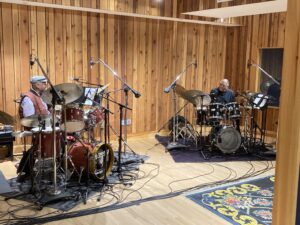 Malaby, Michael Formanek, Kris Davis, Jeff Williams, Rudresh Mahanthappa, Peter Evans, Al Foster, Thomas Morgan, Clarence Penn, Mike Gibbs, Gerald Clever, Paul Dunmall, Tom Rainey, Drew Gress, Ben Monder, Billy Hart, Jason Palmer, Ralph Alessi, Dan Weiss, Noah Preminger, Leo Genovese, Mary Halvorson, Chris Cheek, John Hebert, Rudy Royston, et al.Appearing on more than 80 CDs (with 13 as a leader), his most recent project (‘Ancestral’ on Whirlwind Recordings) features jazz royalty and master drummers Andrew Cyrille and Billy Hart, and guitar virtuoso Ben Monder in a program of original music. Within his discography, recordings in which he has participated have received two Juno Award nominations, two Grammy Award nominations, and one Grammy Award.O’Gallagher is active in jazz education, performing and teaching masterclasses at numerous conservatories around the world. He is the author of ‘Twelve-Tone Improvisation’ published by Advance Music and is currently developing a book from his groundbreaking Ph.D. dissertation on John Coltrane: ‘Analyzing Pitch Structure in Late-Period Recordings of John Coltrane: Interstellar Space and Stellar Regions’.
ANDREW CYRILLE
Master drummer and composer Andrew Cyrille, began studying science at St. John’s University while playing jazz in the evenings. He began 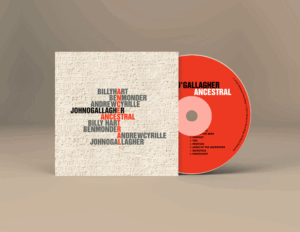 formally studying drums and composition first with Philly Joe Jones in 1958, and later at The Juilliard School and Hartnett School of Music. At that time, he also performed with artists ranging from Mary Lou Williams, Coleman Hawkins, Roland Hanna and Illinois Jacquet to Kenny Dorham, Freddie Hubbard, Walt Dickerson, Rahsaan Roland Kirk, and Nigerian percussionist Babatunde Olatunji among others. Beginning in 1964, Cyrille’s 11-year iconic collaboration with pianist Cecil Taylor would define the category of free jazz drumming and establish Cyrille in the vanguard of jazz drummers and percussionists. Since leaving Taylor’s group, he went on to work with formidable artists as David Murray, Muhal Richard Abrams, Mal Waldron, Horace Tapscott, James Newton, Peter Brötzmann and Oliver Lake. Cyrille was the drummer on Billy Bang’s ‘A Tribute to Stuff Smith,’ notable for being the last studio session of Sun Ra.Cyrille leads his own groups in various formations with luminaries such as Archie Shepp, Roswell Rudd, Marilyn Crispell, Bill Frisell, Richard Teitelbaum, Dave Douglas, Joe Lovano, Jason Moran, Vijay Iyer, David Virelles, Bill McHenry, Ben Street, Henry Grimes, William Parker, Soren Kjaergaard, and others.Cyrille is a recipient of the 2020Doris Duke Artist Award, a 2019 commissioned composer in Chamber Music America’s New Jazz Worksprogram, the 2019 Vision Festival Lifetime Achievement Awardhonoree by Arts for Art, Inc., and a Guggenheim Fellow in Composition (1999).
BILLY HART
William “Billy” Hart (born November 29, 1940 in Washington, D.C.) is a master jazz drummer and educator who has performed with some of the most important jazz musicians in history.Early on Hart performed in Washington, D.C. with soul artists such as Otis Redding and Sam and Dave, and then later with Buck Hill and Shirley Horn, and was a sideman with the Montgomery Brothers (1961), Jimmy Smith (1964–1966), and Wes Montgomery (1966–1968). Hart moved to New York in 1968, where he recorded with McCoy Tyner, Wayne Shorter, and Joe Zawinul, and played with Eddie Harris, Pharoah Sanders, and Marian McPartland.Hart was a member of Herbie Hancock’s sextet (1969–1973), and played with McCoy Tyner (1973–1974), Stan Getz (1974–1977), and Quest (1980s), in addition to extensive freelance playing (including recording with Miles Davis on 1972’s On the Corner).Billy Hart works steadily and teaches widely. Since the early 1990s Hart spends considerable time at the Oberlin Conservatory of Music, and is adjunct faculty at the New England Conservatory of Music and Western Michigan University. He also conducts private lessons through The New School and New York University. Hart often contributes to the Stokes Forest Music Camp and the Dworp Summer Jazz Clinic in Belgium.He leads the Billy Hart Quartet with Mark Turner, Ethan Iverson, and Ben Street, which has released two albums on ECM Records.Hart resides in Montclair, New Jersey.
BEN MONDER